Barrier paper is paper that has been given a job plastic used to do: keep grease in, keep moisture out, protect aroma, or seal shut on a packing line. It is how tea envelopes, sugar sticks, flow-packs and wrapping sheets are moving off plastic laminates without giving up performance.
This guide explains the barriers that matter, how each one is measured, which coating technologies exist and how to choose the right paper for your product, with a selector further down that does the first pass for you.
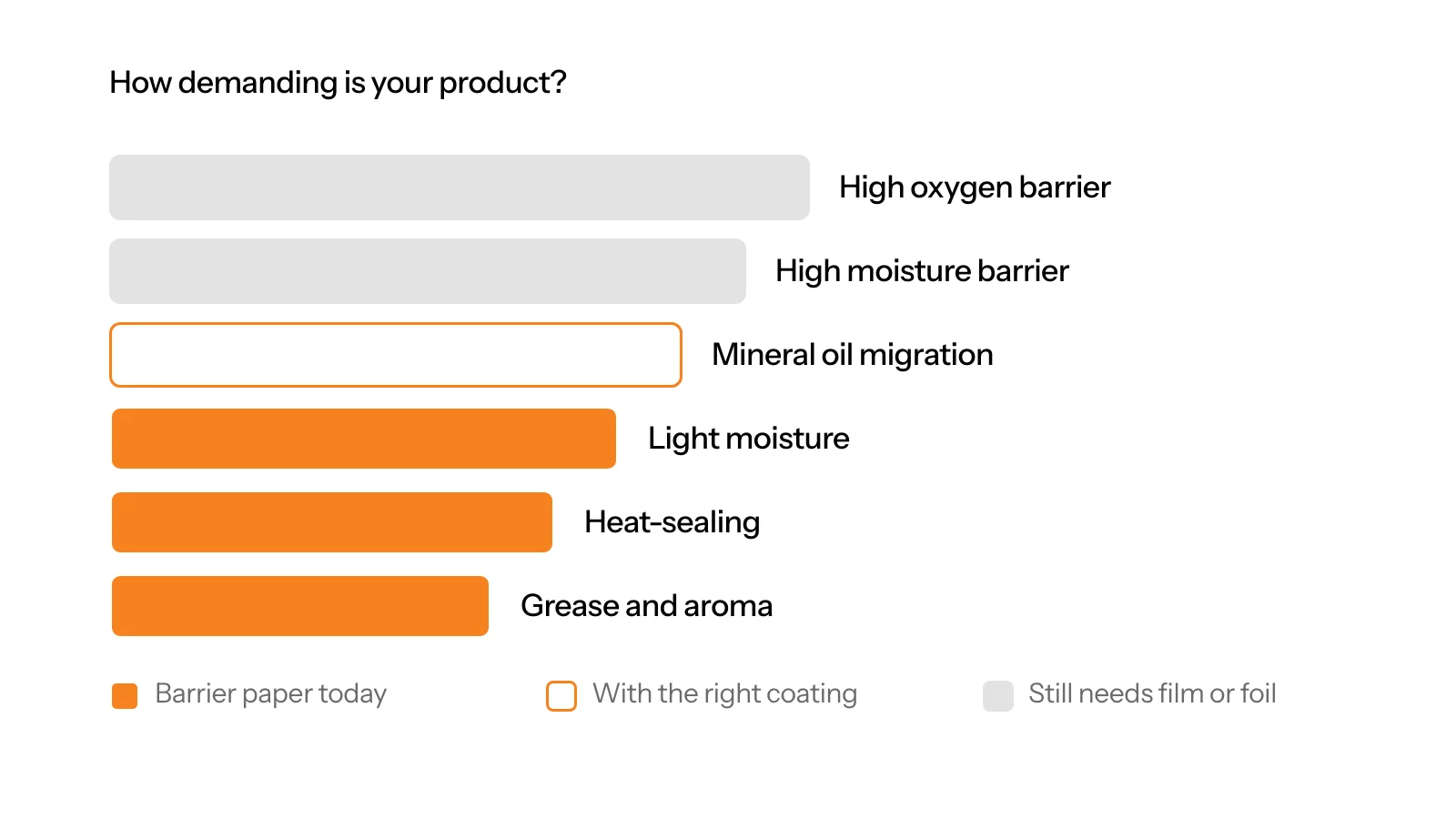
"Barrier paper" is not one thing. Each product needs a different combination of properties, and over-specifying is as costly as under-specifying: every extra gram of coating costs money and recyclability.
| Property | What it stops | How it is measured | Who needs it |
|---|---|---|---|
| Grease resistance | Fat and oil soaking through | KIT test (TAPPI T 559), rated 1–12; 12 is the highest | Tea, spices, bakery, confectionery, food service |
| Moisture barrier | Water vapour passing through | WVTR / MVTR in g/m² per day; lower is better | Dry snacks, powders, products that go soft or cake |
| Oxygen barrier | Oxygen reaching the product | OTR in cm³/m² per day; lower is better | Coffee, nuts, long-shelf-life foods |
| Mineral oil barrier | MOSH/MOAH migrating from inks or recycled fibre | Migration testing | Dry food in direct contact, especially with recycled board nearby |
| Heat sealability | (Not a barrier: it lets the pack close) | Seal strength across a temperature window | Anything packed on HFFS, VFFS or envelope lines |
Most dry food needs grease resistance and heat sealing first. Moisture and oxygen are where paper still has limits, and where an honest supplier will tell you so.
There are five ways to give paper a barrier. They differ less in how well they work on day one than in what happens to the pack afterwards.
| Technology | How it works | Paper recycling | Watch out for |
|---|---|---|---|
| Water-based dispersion coating | A thin polymer dispersion applied in one or more layers | Designed for it; can reach PAP 22 | Oxygen and moisture barrier still falls short of multilayer films |
| PE extrusion or lamination | A plastic film bonded to the paper | Composite; often a separate fee band | PPWR recyclability grades from 2030 |
| Wax | Paraffin or similar applied to the sheet | Poor; disturbs repulping | Rejected by many paper mills |
| Fluorochemical treatment | PFAS-based grease repellency | Contaminates the fibre stream | PPWR PFAS limits in food-contact packaging since 12 August 2026 |
| Aluminium foil or metallisation | A metal layer laminated or deposited | Composite | Highest barrier, hardest to recycle in the paper stream |
Water-based dispersions are where the industry is moving, because they combine a usable barrier with paper recycling. The engineering challenge is doing it in very few grams. Our current heat-sealable platform uses about 2.5 g/m² of coating on 70 g/m² paper, applied in thin, even layers rather than one heavy coat.
For flexible packaging, the barrier coating usually doubles as the seal layer. When the jaws of a packing machine heat it, the coating softens and bonds to itself, closing the pack like a PE film would.
Two numbers matter here. The sealing window is the temperature range in which the paper seals reliably; a wide window, such as 100–130 °C, means operators do not need to recalibrate the machine or slow it down. The seal strength decides whether the pack survives transport. On machines with very narrow sealing jaws, a standard coating may not bond at all, which is why we developed a high-tack coating that activates at lower temperatures for a sugar stick line with ultra-narrow jaws.

Pick the product closest to yours. The answer is a starting point for a conversation, not a specification.
Grease and aroma barrier, heat-seal. A water-based heat-sealable barrier paper (KIT 12) is a proven fit on IMA, Teepack and Fuso lines, and can stay PAP 22.
Light grease barrier, heat-seal, optional window. Kraft or white barrier paper on HFFS or VFFS lines, with a transparent cellulose window if shoppers need to see the product.
Grease barrier first, then moisture. Barrier paper usually works; check the fat content and target shelf life, and test on your line before switching.
Low-temperature, high-tack heat-seal. The coating must bond on small sealing areas without changing the machine.
Grease barrier, no heat-seal needed. Grease-resistant wrapping paper, printed and cut to size, replaces waxed or PE-coated sheets.
Moisture, fat and dead-fold. Paper alone is not enough yet for most of these; an aluminium/paper laminate is the reliable option today.
High oxygen barrier. Paper coatings do not reach this level yet. A compostable or high-barrier laminate is the honest choice for now.
A short brief saves weeks of trials. These are the questions we ask on every project:
The honest limit
Water-based barrier papers do not yet match multilayer films on oxygen and moisture. For vacuum coffee, fatty or wet products and very long shelf lives, paper alone is not the answer today. Chemical suppliers and converters, including us, are working on it.
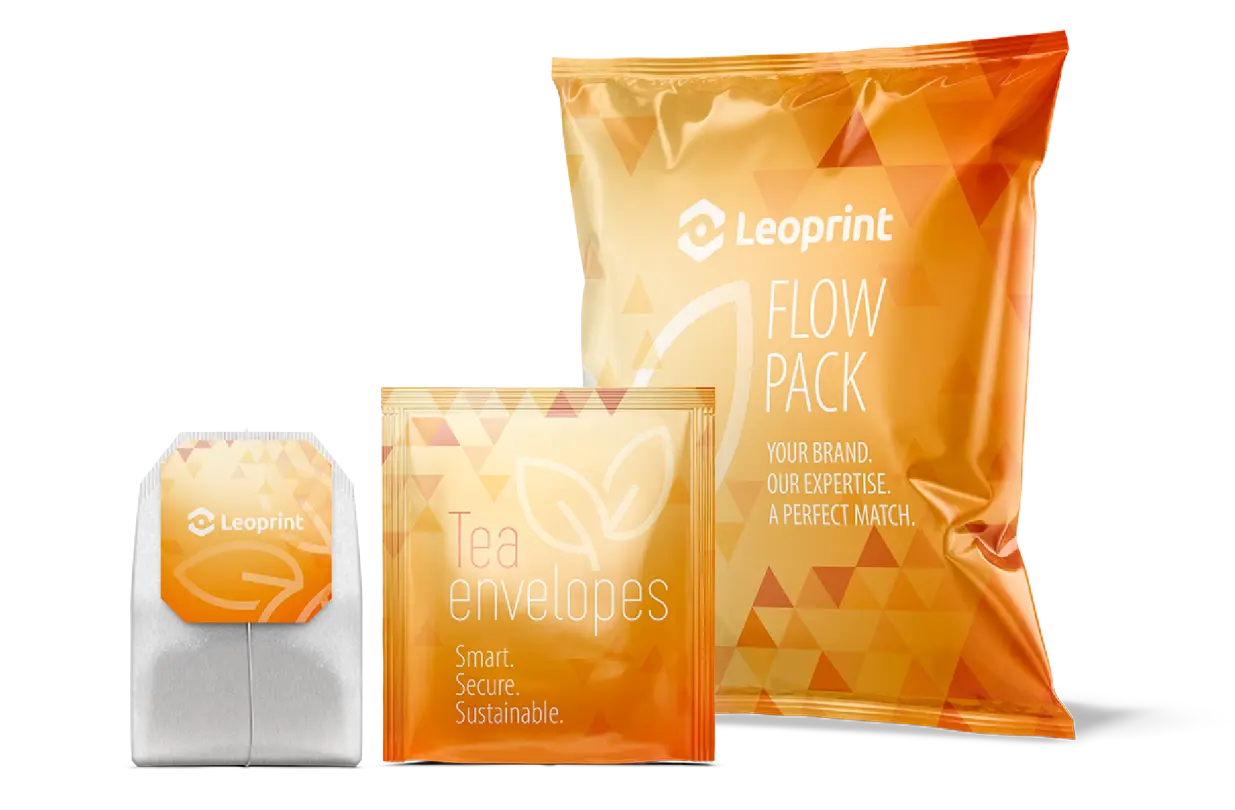
There are two ways to work with us. If you pack products, we supply printed, converted packaging made from our own barrier paper: flow-pack paper, tea envelopes or wrapping sheets. If you convert paper yourself, our barrier coating and conversion service coats Kraft, Testliner or graphical papers and delivers slit reels, sheets or die-cut blanks for your line.
Either way, the first step is the same: tell us the product and the machine, and we will send a sample to test on your line before you commit.
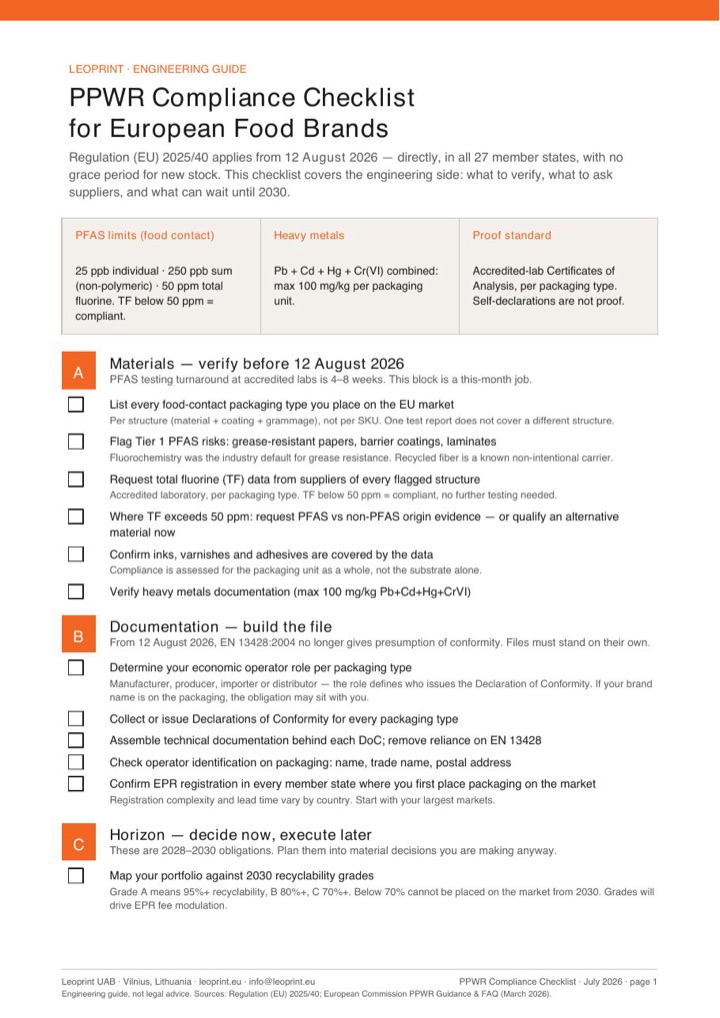
A two-page checklist for getting food packaging ready for the EU PPWR: PFAS limits, Declarations of Conformity, EPR, and what can wait until 2030.
Tell us your product and your packing machine. We will recommend a paper and send a sample to run on your line before you commit.
On a labelling line, a self-adhesive label is a small piece of engineering. How labels are made, how to choose materials and adhesives, and which roll details prevent first-delivery problems.
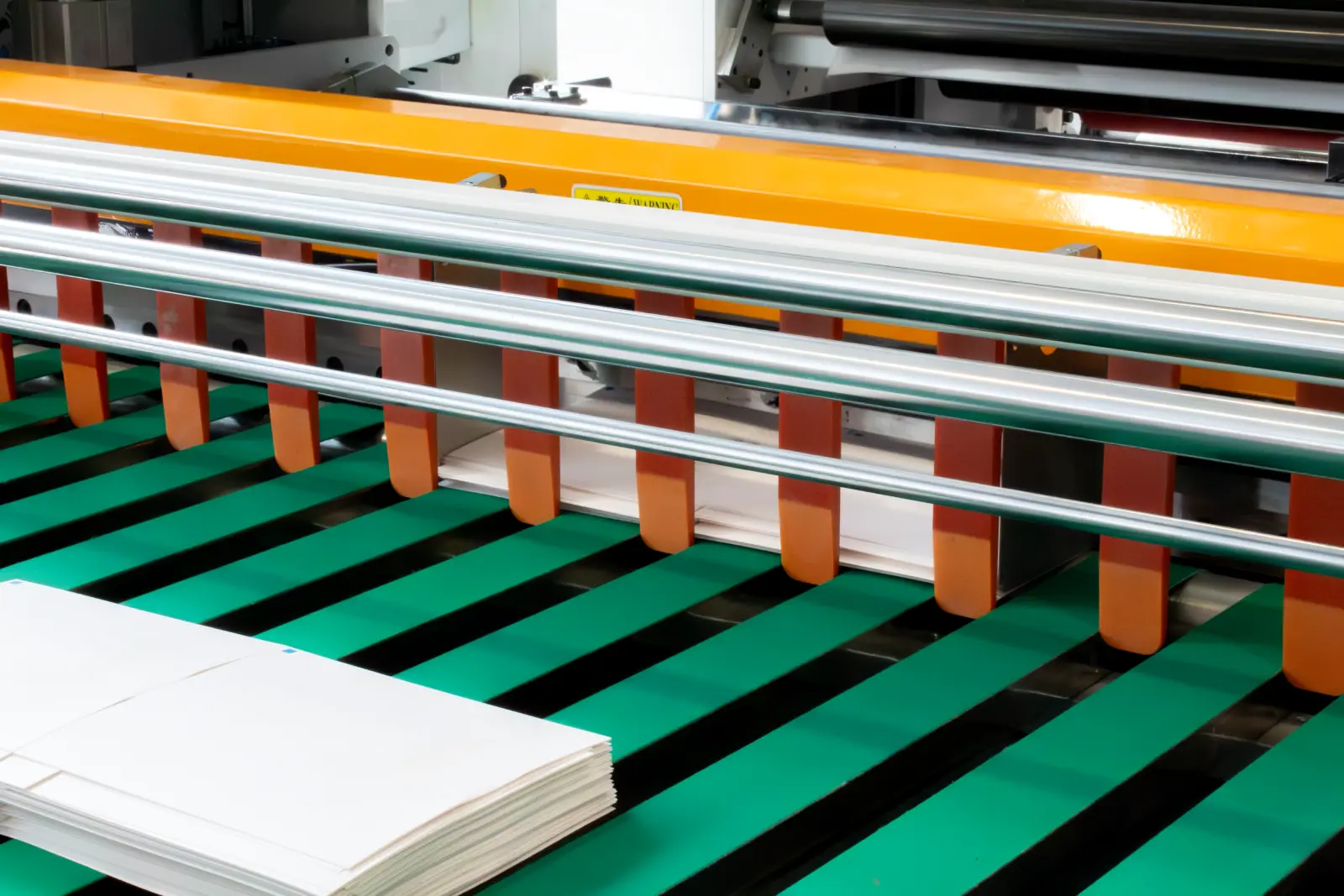
Most paper packaging and labels are printed flexo. How the press works, where it shines and where it needs care, and how to prepare artwork so your first run goes straight to plate-making.
PAP 22 is printed on paper bags, flow-packs and tea envelopes everywhere, but rarely explained. What the code means, when a coated paper still counts as paper, and what the code does not prove.
.svg)
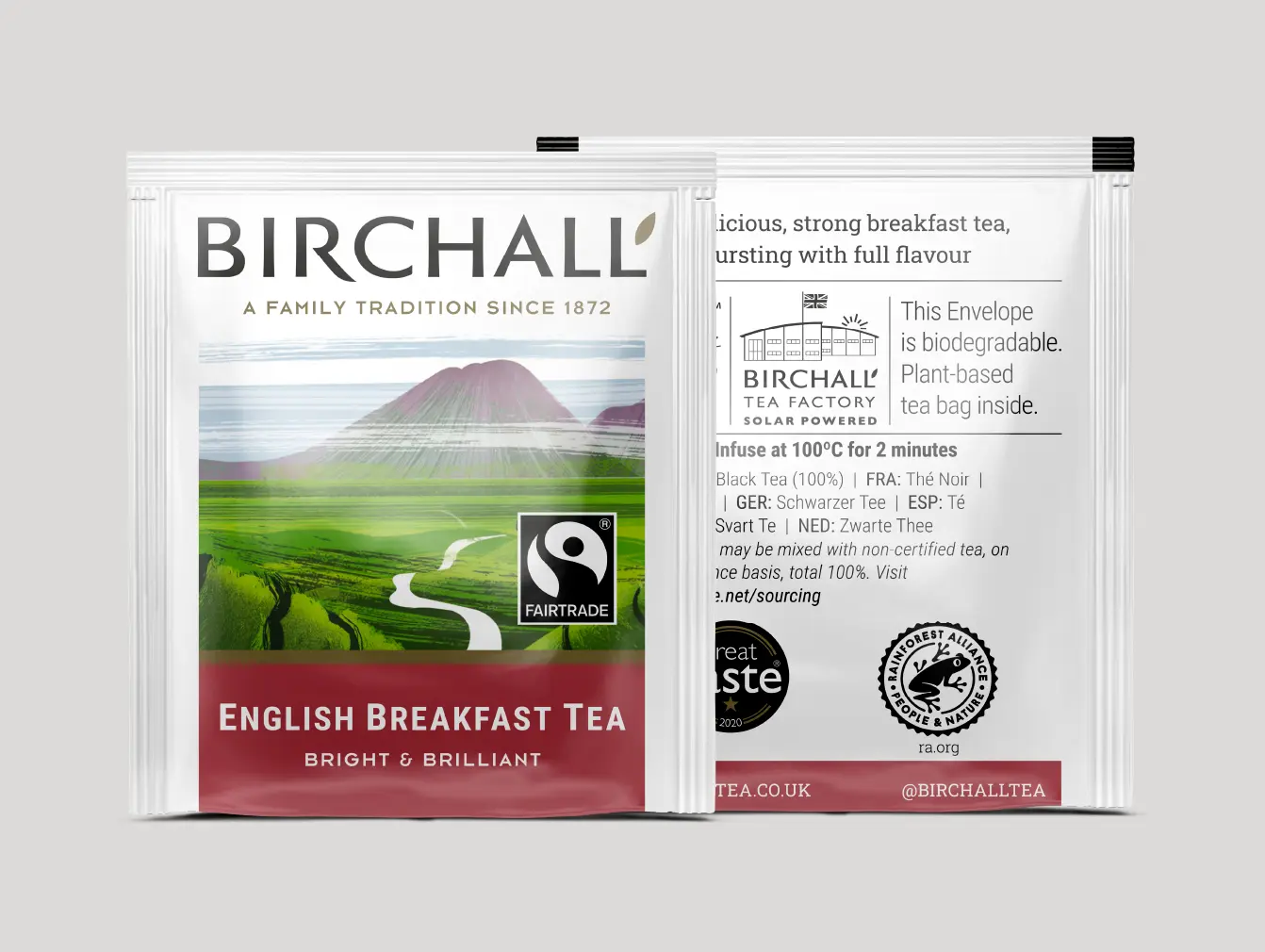
Replaced plastic with a recyclable barrier paper engineered to run flawlessly on fast packing machines without compromising the premium tactile feel.
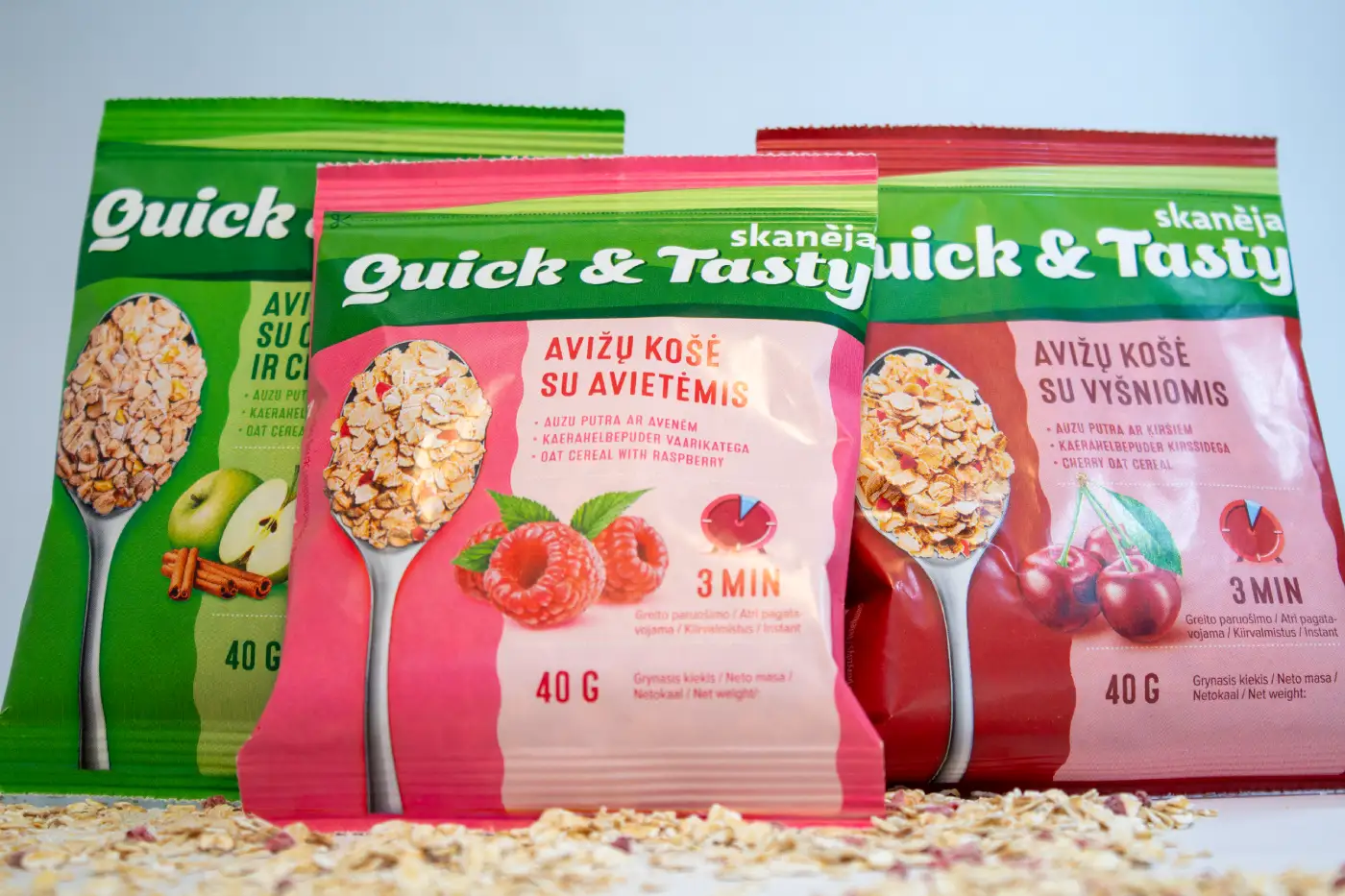
A recyclable paper alternative (PAP 22) that matched the mechanics of legacy plastic films, requiring zero speed loss or expensive machine modifications.
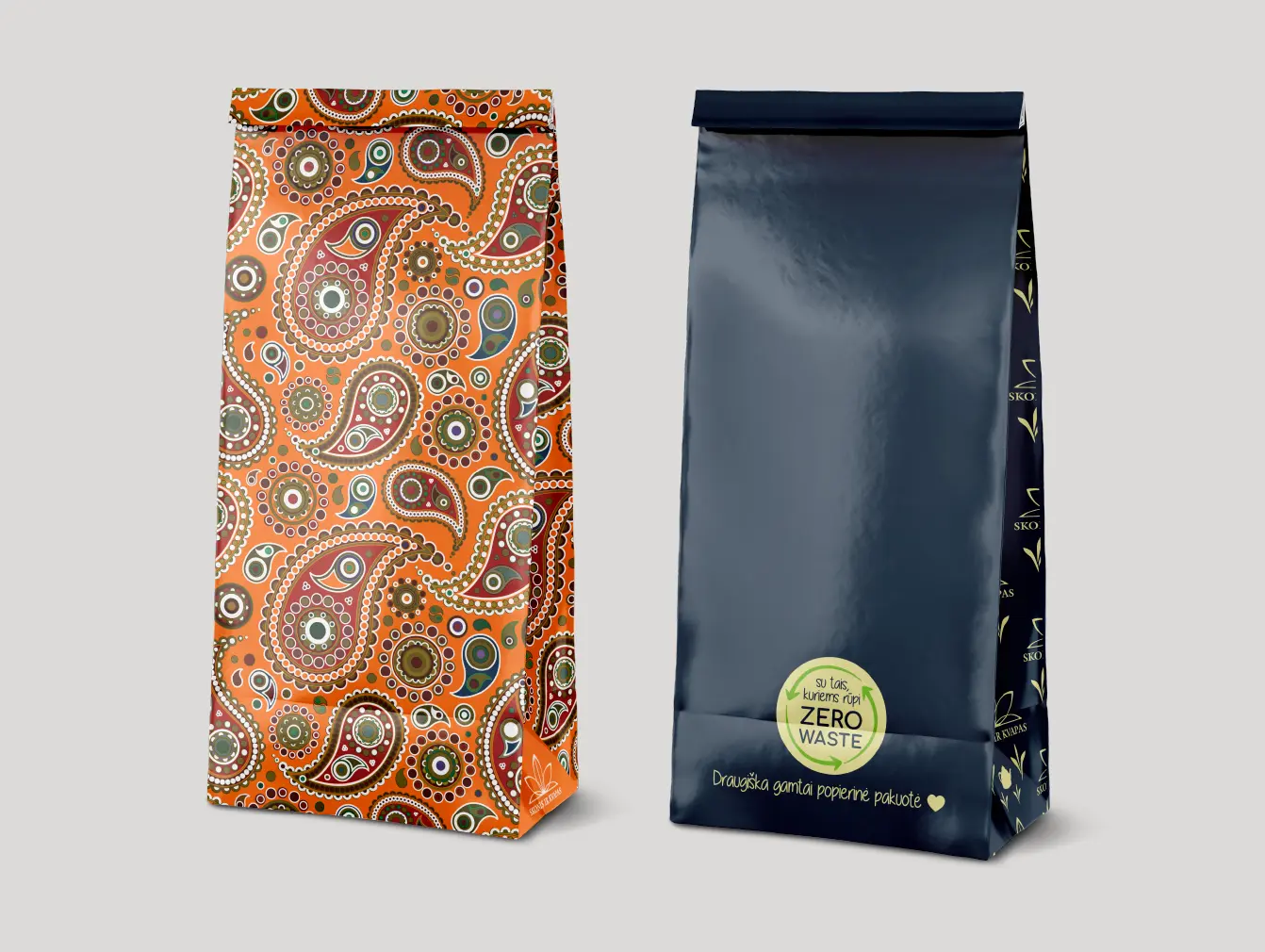
Proving that mono-materials can look premium. We engineered a protective barrier coating that maintains shelf-life while allowing for intricate, vibrant flexo printing.
Replaced plastic with a recyclable barrier paper engineered to run flawlessly on fast packing machines without compromising the premium tactile feel.
A recyclable paper alternative (PAP 22) that matched the mechanics of legacy plastic films, requiring zero speed loss or expensive machine modifications.
Proving that mono-materials can look premium. We engineered a protective barrier coating that maintains shelf-life while allowing for intricate, vibrant flexo printing.
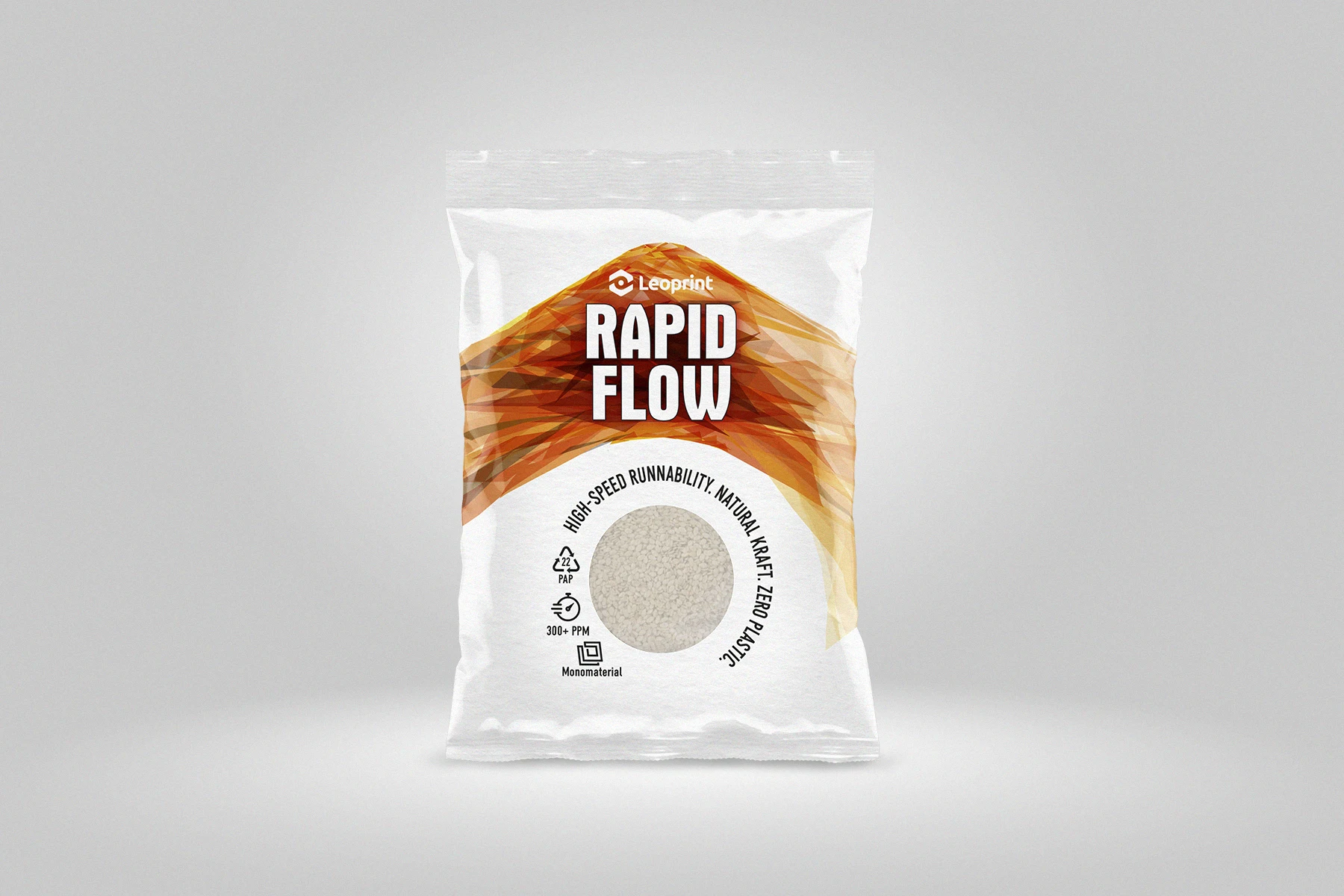
We engineered a PAP 22 kraft paper flow-pack with a crystal translucent window — a direct drop-in for BOPP/PE films, validated at 300+ PPM with zero machine modifications.
.svg)
Printing isn't magic; it's physics. We control the variables so you don't have to.

.svg)
.svg)